


Brazil’s SECEX opens consultation on bilateral safeguards
In brief
Brazil’s Foreign Trade Secretariat (SECEX) has opened a public consultation on the draft Ordinance regulating bilateral safeguards investigations, complementing Decree No. 12,866/2026. These temporary measures allow Brazil to suspend or reduce tariff preferences granted to a trading partner when the increase in benefited imports causes or threatens to cause harm to the domestic industry. The new rules will apply to existing agreements, such as Mercosur-European Union, and to future ones.
Interested parties can contribute through the Brasil Participativo platform until December 3, 2026.
The investigations will largely follow the model of anti-dumping and countervailing measures investigations, but with significant differences in deadlines, extensions, and other aspects defined by the applicable agreement in each case.
Main conclusions
- The investigations will be conducted by the Department of Trade Remedies (DECOM) of SECEX, an agency that already acts as the investigative authority in antidumping, subsidies, and global safeguards cases.
- The draft provides for shorter instruction periods and specific rules for extension requests. These points require planning both from industries intending to seek measures and from companies that may be affected by them.
- Various elements, such as industry representativeness, duration, and form of the measure, will be defined by the applicable trade agreement, such as those signed by Mercosur. Therefore, the analysis must consider the rules of each agreement on a case-by-case basis.
- The public consultation represents an opportunity to present suggestions before the issuance of the final standard. The office remains available to assess the potential impacts of the proposal and support the preparation of contributions.
More details
A bilateral safeguard is a temporary and emergency measure. Unlike anti-dumping and countervailing measures, it does not presuppose the existence of unfair trade practices. Its basis is the increase in imports originating from a trading partner as a result of tariff preferences negotiated in the agreement. It also differs from the global safeguard, which covers imports from all origins, while the bilateral safeguard is restricted to imports from the agreement partner. Measures may consist, for example, of suspending the tariff reduction schedule or reducing the granted preference.
Decree No. 12,866/2026 defined the general rules for the investigation and application of these measures. The draft under consultation details the procedure: petition requirements, handling of confidential information, processing deadlines, review for extension, and anti-circumvention review. The new rules will apply both to existing trade agreements, such as Mercosur-European Union, and to future agreements.
The proposed structure largely reproduces the model applied to antidumping and subsidy investigations. DECOM conducts the investigation, SECEX decides on the start and closure of investigations, and the implementation of measures is the responsibility of the Executive Management Committee of the Foreign Trade Chamber (GECEX). Cases are processed electronically in SEI, with confidential and restricted versions of documents. Once the investigation is initiated, the involved trading partner is notified within up to seven days.
The main procedural instruments follow the antidumping model, with shorter deadlines, as detailed below:
- Admissibility of the petition: DECOM will have 20 days to analyze the petition. If there are pending issues, the petitioner will have 10 days, extendable for an equal period, to resolve them. The petition may be denied if there is no response or if the information or indications are insufficient to start the investigation.
- Questionnaires: 30 days for response, extendable for only 10 days (in anti-dumping cases, the extension reaches 30).
- Verifications: can be on-site, documentary, or by other means, in person or remotely.
- CODIP: as with anti-dumping regulations, the petition must include a proposed product identification code (CODIP), with a description and justification of the characteristics considered. Interested parties may comment on the proposal within 10 days of the start of the investigation, and DECOM may review the composition of the CODIP ex officio or based on these statements.
- Anticircumvention: the hypotheses are the same as for antidumping (assembly in Brazil or in a third country with parts of the origin affected and marginal modifications in the product), but without the objective criteria of that regime, such as percentages of 60% shares and 35% added value. The determination will depend on the joint analysis of the evidence.
Unlike a global safeguard, which covers all origins, a bilateral safeguard only affects the preferential imports of the other party to the agreement. The agreement, which will prevail over the regulatory Ordinance, defines the standard of injury, the requirement of a causal link, the form, duration, and extension of the measure, and the possibility of provisional measures.
The main differences compared to anti-dumping are as follows:
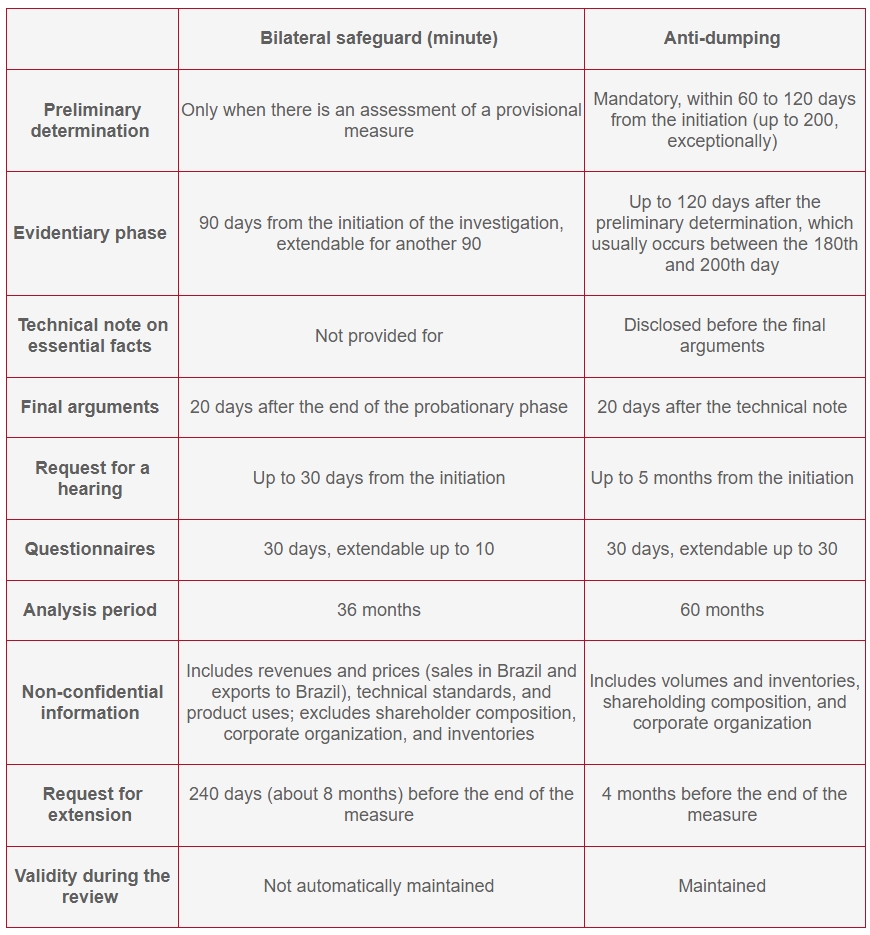
The expansion of tariff preferences in trade agreements tends to increase the relevance of this instrument, both for industries that may seek measures and for importers and exporters who may be affected by them.
The public consultation is the appropriate moment for companies to assess how the proposed rules apply to their reality and to present suggestions regarding deadlines, confidentiality, and other points of interest before the issuance of the definitive regulation.
Contributions must be submitted through the Brasil Participativo platform by December 3, 2026.