


Supplementary Law No. 236/2026 amends the CTN and establishes new rules on penalties, compliance, and tax litigation
In brief
On September 4, 2026, Supplementary Law No. 236/2026 was published, taking effect on the date of its publication. The statute amends the Brazilian National Tax Code (CTN) to establish general rules on dispute resolution, consensual mechanisms, and administrative proceedings in tax and customs matters.
Among the main highlights of the new legislation are the following:
- Establishment of general caps for tax penalties of up to 75% of the tax, which may reach 100% in cases of fraud, tax evasion, or collusion, and 150% in the event of recidivism.
- Creation of mechanisms for the reduction of penalties in the event of payment or installment payment of the debt, with more favorable percentages for taxpayers participating in tax compliance programs.
- Express provision that voluntary disclosure also excludes the late-payment penalty, incorporating an understanding already settled in case law.
- Introduction of general rules on self-regularization and compliance programs, reinforcing preventive mechanisms aimed at reducing tax disputes.
- Creation of general national rules for administrative tax proceedings, including minimum procedural deadlines, counting in business days, suspension of deadlines between December 20 and January 20, and rules on administrative appeals.
- Binding of the Tax Authority to qualified precedents of the Brazilian Federal Supreme Court (STF) and the Brazilian Superior Court of Justice (STJ), with restrictions on the issuance of tax assessment notices and on entry in the outstanding tax debt register in matters definitively decided in favor of taxpayers.
- Inclusion of tax arbitration and mediation in the CTN as dispute-resolution mechanisms, the implementation of which will depend on specific legislation.
- Expansion of the grounds for suspending the enforceability of the tax claim, including tax settlement, mediation, arbitration, and certain guarantees provided in tax foreclosure proceedings.
- Provision of a two-year term for the adaptation of the legislation of the federative entities to the new rules on administrative tax proceedings and, in certain cases, on the calibration of penalties.
- Maintenance of relevant presidential vetoes relating, among other matters, to the tax liability of third parties, co-liability in the outstanding tax debt register, and the interruption of the statute of limitations.
Despite the law’s immediate entry into force, several provisions will depend on specific regulation or on adaptation by the tax administrations for full implementation.
Further details
The main changes introduced by the supplementary law into the Brazilian National Tax Code are as follows:
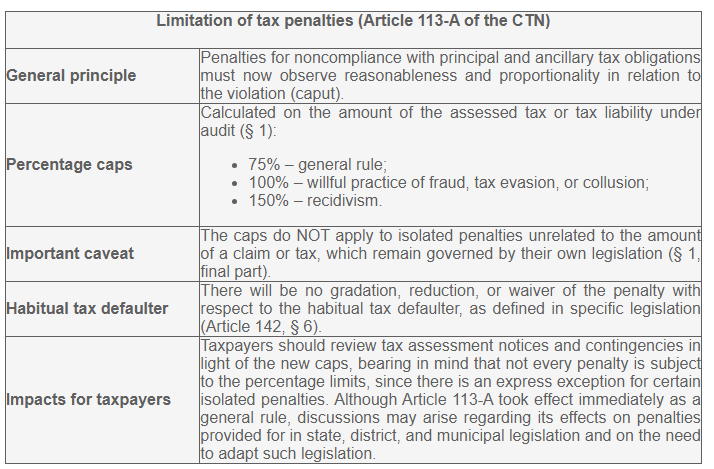
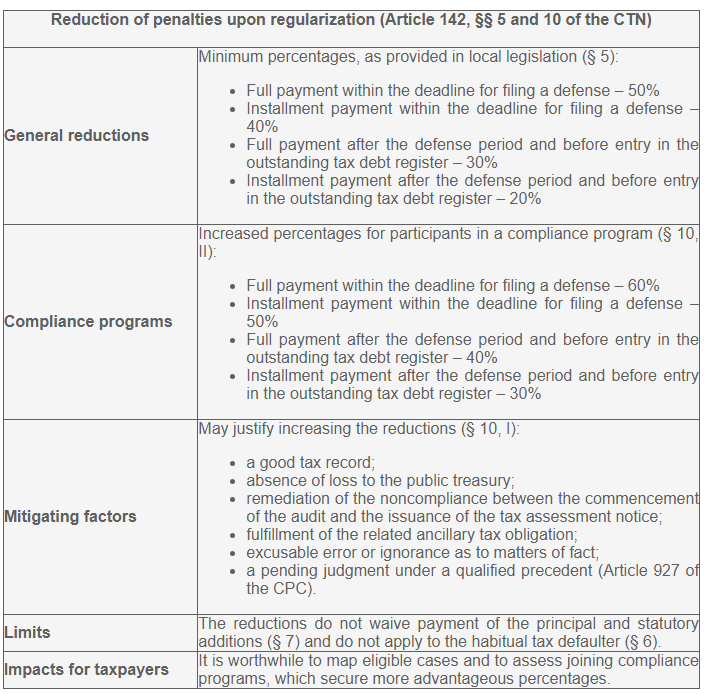
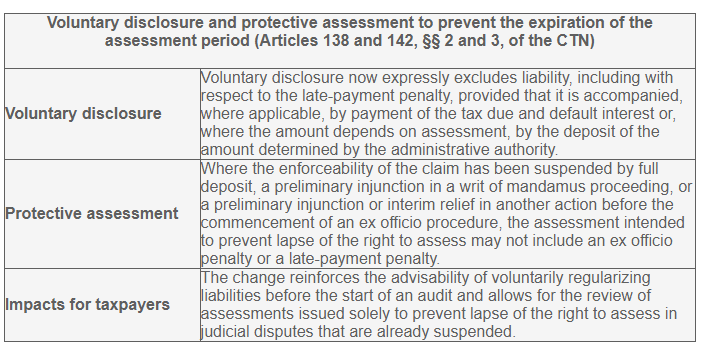
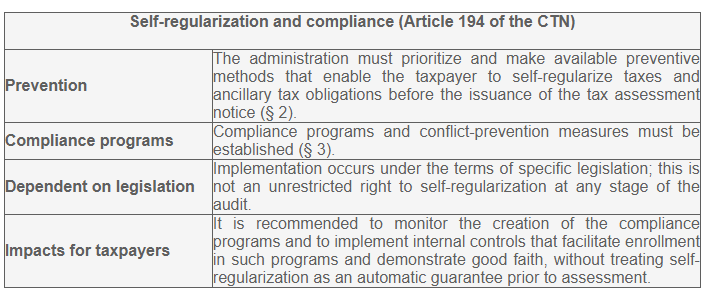
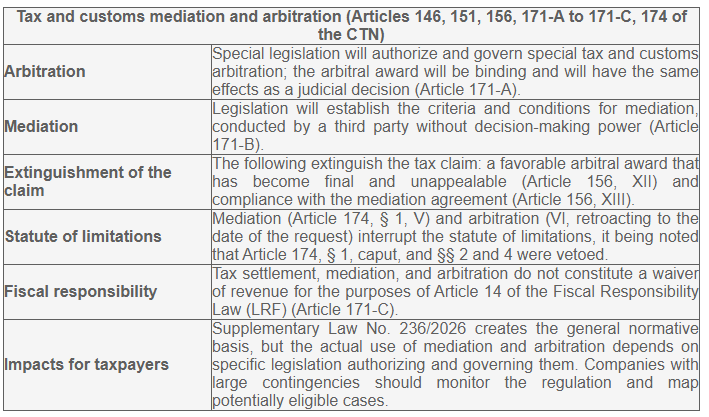
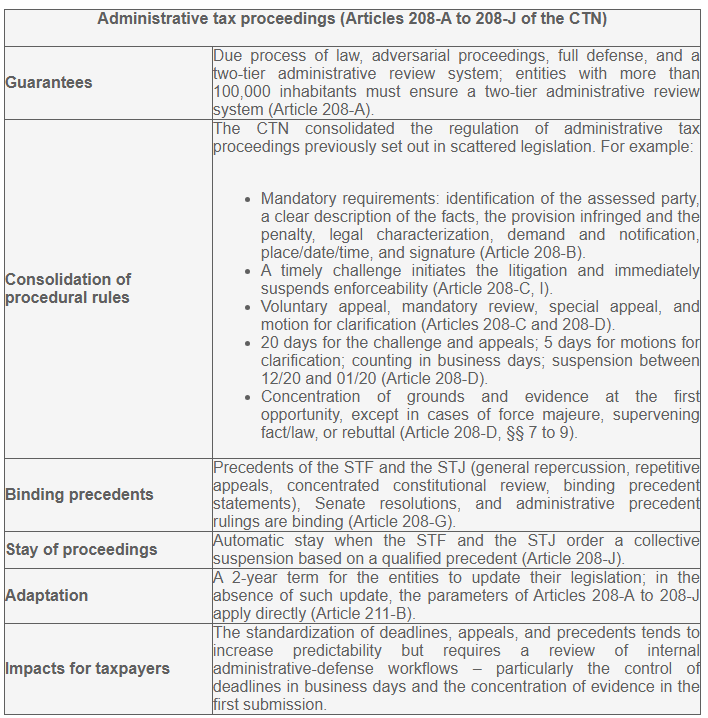
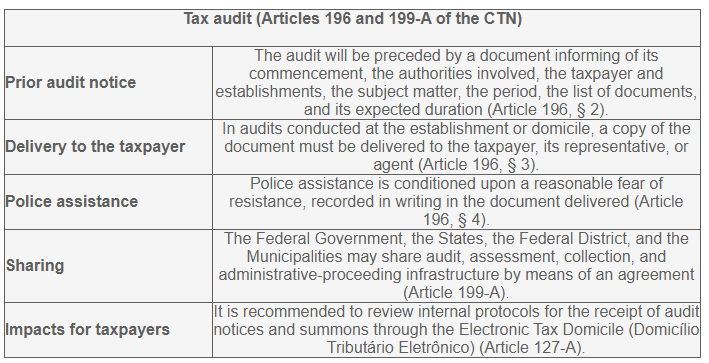
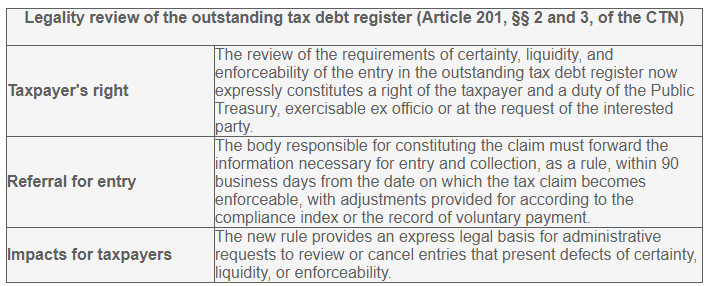
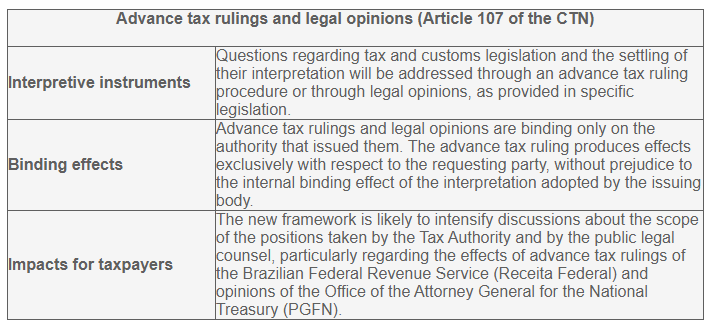
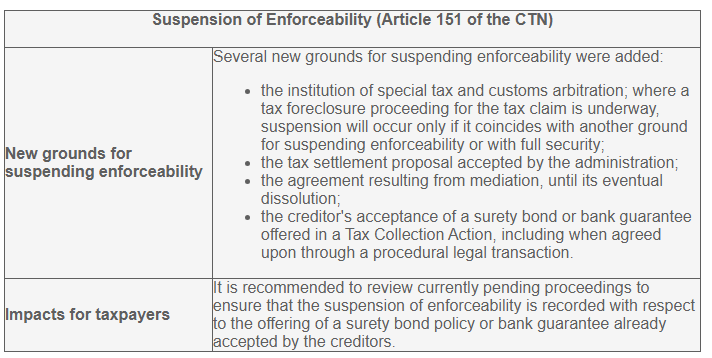
With the entry into force of Supplementary Law No. 236/2026, from a practical standpoint, companies have the opportunity to review tax assessment and contingencies in light of the new penalty parameters, identify disputes covered by binding precedents, reassess their respective administrative-defense workflows, and monitor the implementation of compliance programs, self-regularization mechanisms, mediation, and arbitration. It will also be possible to review procedures relating to guarantees and entries in the outstanding tax debt register.
Lastly, several provisions of the text submitted for presidential sanction were vetoed and may be reconsidered by the National Congress. Among the main vetoes are the following:
- The isolated penalty restricted to cases of false declaration;
- The restriction of joint liability to those who acted directly in the taxable event;
- The requirement of a prior determination of third-party liability and the definition of recidivism;
- The waiver of the statute of limitation period in the offsetting of an overpayment judicially recognized, so as to allow full use of the credits;
- The interruption of the statute of limitations “only once”;
- The requirement of a prior determination in order to identify co-responsible parties in the entry in the outstanding tax debt register; and
- The expansion of the grounds for nullity in the administrative tax proceedings (PAF).